Home KB.
Case study

Dressed for Success

How what college seniors wear to class shapes their confidence, identity and how professional they feel as they head into the workforce.

Course
MKTG 385, Consumer Behavior
Method
Qualitative, one-on-one interviews
Team
Group of five
Deliverable
41-page research report with full transcripts
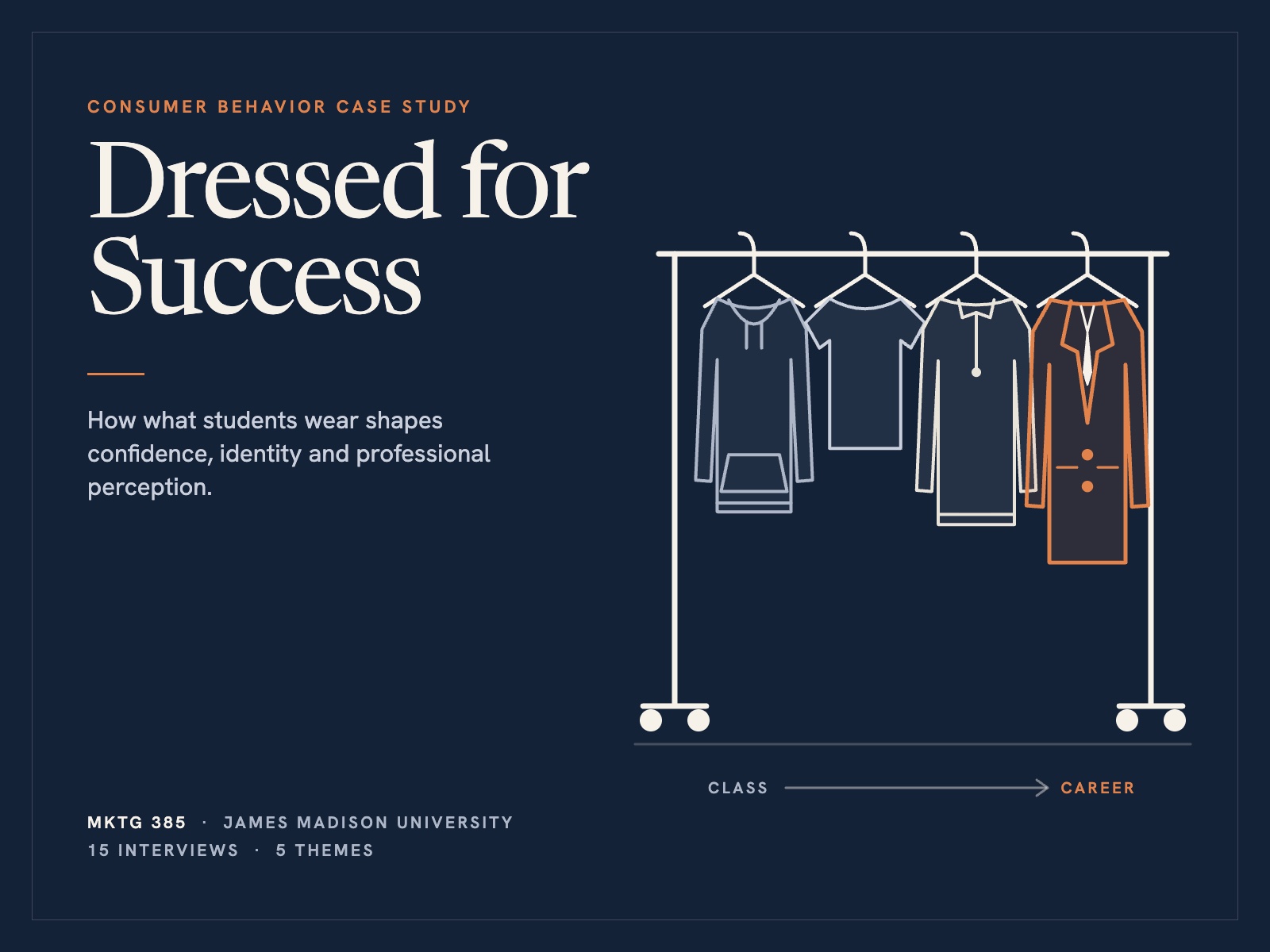
The Dressed for Success cover: a clothing rack in navy and cream that moves from a hoodie, T-shirt and quarter-zip to an orange blazer, with an arrow from Class to Career
From class to career, the shift our study looked at.

The question

How does the way students dress for class affect their confidence, identity and sense of professionalism as they get ready for their careers?

Picking an outfit looks like a small decision. For seniors about to start careers, it says a lot about who they are and how they want to be seen.

We aimed at JMU seniors because they’ve been through the most phases of college and are now heading into internships, career fairs and first jobs. They’re also the generation that grew up comparing themselves online, which makes self-image and first impressions feel even higher-stakes. We wanted to know whether they’re starting to dress for the professional world, and what that does for them.

What the research already said

  • Fashion can lift confidence and self-expression, and shape overall mindset (Jinnah, 2022).
  • Clothing affects mood, self-esteem and behavior (Lopez).
  • Fashion helped one writer’s mental health by making her feel more comfortable, expressive and confident (Stewart, 2021).
Who we talked to

Fifteen students, eleven majors

Mostly seniors aged 20 to 22, from finance to elementary education. All names are pseudonyms.

15

one-on-one interviews, three per researcher, recorded and transcribed word for word

11

different majors, so the findings aren’t just a business-school view

14/15

described a casual, comfort-first outfit for an ordinary class day

14/14

of those we asked said they dress up for interviews, presentations or networking

Interviewed by me

How we did it

  1. Framed the question

    Read up on the psychology of fashion and confidence, then chose seniors as the group in the middle of the shift.

  2. Wrote the guide

    Brainstormed questions as a team, sharpened the wording and kept the 15 strongest, all open-ended and neutral.

  3. Interviewed

    Each of us ran three one-on-one interviews over Zoom or in person, with pseudonyms to protect participants.

  4. Transcribed

    Every interview written out word for word, so the analysis stayed true to what people actually said.

  5. Coded and themed

    Tagged recurring ideas like comfort, confidence and career preparation, then grouped them into five themes.

The interview guide

Every participant got the same 15 questions, moving from everyday habits to identity and the future, with follow-ups like “Can you tell me more about that?”

  1. What is your class year and your major?
  2. How would you describe your typical outfit for class?
  3. What usually goes through your mind when you are deciding what to wear to class?
  4. When you think about dressing professionally, what does that mean to you?
  5. In what way do you think your class year influences how you feel you should dress for class?
  6. Do you notice differences in how freshmen, sophomores, juniors and seniors dress around campus?
  7. How does your major or career goals impact how you dress for class?
  8. How does what you wear to class affect how confident or prepared you feel?
  9. Looking back, what is the biggest change in how you dress now compared to when you first started college?
  10. Do you dress differently for interviews, presentations or networking events? Why?
  11. How do you think expectations around professional dress connect to your future career?
  12. Can you describe a time when you wore an outfit that made you feel most confident?
  13. As you prepare to enter the workforce, how do you think clothing influences your confidence or sense of identity?
  14. How prepared do you feel to dress appropriately for your future job?
  15. Is there anything else about clothing, confidence or entering your career that feels important to share?
By the numbers

What the transcripts show

Every student answered the same questions, so their answers can be counted. Hover or tap any bar to see who said it.

Question 3

What decides the outfit

10 of 15 mention the weather. Only one mentions mood.

Weather10 of 15
Comfort or convenience8 of 15
What’s on that day4 of 15
Looking put together3 of 15
Mood1 of 15
Question 12

Their most confident outfit was for…

13 of 15 picked a school or work moment, not a social one.

A presentation4 of 15
A career fair, interview or meeting4 of 15
Everyday business casual4 of 15
A social event2 of 15
An exam1 of 15
Question 8

Does what you wear change how confident you feel?

11 of 15 say dressing up helps.

  • Dressing up helps (11)
  • Comfort helps more (2)
  • No effect (2)
Question 9

Since freshman year, they now dress…

An almost even split. College pushes some people up and some people down. Asked of 14.

  • Dress more casually (5)
  • About the same (3)
  • Dress nicer (6)
Question 6

Who dresses up more on campus?

No consensus: 5 say freshmen, 6 say upperclassmen.

  • Freshmen (5)
  • No difference or unclear (4)
  • Upperclassmen (6)
Question 14

How ready is their wardrobe for work?

1 in 5 aren’t there yet. All three say they still need to buy work clothes.

  • Very prepared (6)
  • Mostly prepared (6)
  • Still learning or not prepared (3)
See every participant’s coded answers
StudentQ3 deciding factorsQ6 who dresses upQ8 confidenceQ9 since freshman yearQ12 most confidentQ14 ready for work
EllieWeather, comfortNo real differenceDressing up helpsMore casuallyCareer fairMostly
EllaWeather, moodUpperclassmenDressing up helpsNicerMeeting a program directorStill learning
AnneComfort, looking put togetherFreshmenDressing up helpsMore casuallyBusiness casual on campusVery
AidenLooking put togetherUnclearDressing up helpsNicerQuarter-zip and khakisVery
DerekWeatherFreshmenComfort helps moreNot askedFootball tailgateVery
MatthewComfort, weatherNo real differenceDressing up helpsAbout the sameCareer fairMostly
NoahLooking put togetherUpperclassmenComfort helps moreAbout the sameInternship interviewNot prepared
HaileyComfort, weatherUpperclassmenDressing up helpsMore casuallyClass presentationVery
AugustaWeatherNo real differenceNo effectAbout the sameClass presentationVery
MaddyComfortFreshmenDressing up helpsNicerA weddingMostly
SarahWeather, comfort, the dayFreshmenDressing up helpsMore casuallyClass presentationStill learning
EmilyComfort, the dayFreshmenNo effectMore casuallyStudent teachingVery
MaxWeather, the dayUpperclassmenDressing up helpsNicerClass presentationMostly
MindelWeather, comfortUpperclassmenDressing up helpsNicerBusiness casualMostly
SteveWeather, the dayUpperclassmenDressing up helpsNicerAn examMostly

Coded from our 15 transcripts. Where someone gave more than one reason, each one counts, so the question 3 bars add up to more than 15.

What we found

Seniors dress for comfort day to day, then switch when it counts, and they feel the difference.

  1. 01

    Comfort vs. professionalism

    On ordinary days, comfort wins: weather, long days on campus and no one left to impress. Professional dress works like a switch they flip for the moments that matter.

    • Comfort
    • Convenience
    • Weather
    • Casual clothing
    • Situational dressing
    • Productivity
    “The more comfortable I am, the more productive I can be.”Derek, junior, graphic design
    “I do want to look presentable but I also prefer comfort a lot of the time.”Anne, senior, accounting and finance
  2. 02

    Dressing up builds confidence

    Again and again we heard “look good, feel good.” Nicer clothes went with a better mood, a more serious mindset and stronger presentations.

    • Confidence
    • Preparedness
    • Motivation
    • Mindset
    • Feeling “put together”
    • Self-perception
    “When I wear something nicer, I feel more confident. I also feel more comfortable talking to people.”Max, senior, finance
    “When I look more put together, I feel more put together.”Maddy, senior, elementary education
  3. 03

    Growing into the workforce

    As graduation gets closer, clothing becomes part of career prep, especially for business and finance majors, who tie what they wear now to the jobs they want.

    • Career preparation
    • Workforce expectations
    • Maturity
    • Future career mindset
    “Since I want to work in business, I try to wear nicer clothes to class, especially when I have a presentation or a meeting.”Steve, senior, finance
    “I feel like I’m on track for my career.”Emily, senior, elementary education, on dressing for student teaching
  4. 04

    First impressions

    Students know clothes speak before they do. Dressing well gets them taken seriously by recruiters, professors and peers.

    • Social pressure
    • Presentability
    • Respect
    • Professional image
    • Taken seriously
    “First impressions matter in professional settings.”Mindel, senior, finance
    “People take you more seriously if you’re put together and dressed up.”Sarah, senior, marketing
  5. 05

    Clothes as identity

    Professional dress isn’t only about rules. Students want their personality to show, and dressing the part helps them picture themselves in the career.

    • Self-expression
    • Authenticity
    • Personality
    • Identity
    “Clothes can communicate a lot about who you are, your style, what things you like.”Ella, senior, psychology
    “A lot of aspects of identity are represented in clothing.”Anne, senior, accounting and finance

Also in the transcripts: the wardrobe gap

Several students said they still need to build a work wardrobe, and cost gets in the way. That gap is an opening for brands that can make professional clothes feel affordable and wearable every day.

“Definitely not prepared at all, because it’s very expensive to buy a lot of suits.”Noah, junior, political science, heading into a suit-and-tie internship
My interviews

Three finance seniors

All three already think of clothes as part of their career, and each added something the rest of the data didn’t.

Max · senior, finance
“It is better to look professional than underdressed.”

An internship that required khakis and a golf shirt every day made him comfortable dressing up. He still worries about being too formal, but dresses up for presentations even when professors say it isn’t required.

Me:How does what you wear to class affect how confident or prepared you feel?Max:“When I wear something nicer, I feel more confident. I also feel more comfortable talking to people.”
Mindel · senior, finance
“Dressing better makes me feel smarter and more prepared.”

He’s already moved to polos and cleaner outfits because that’s how he expects to dress at work. He also noticed standards have relaxed since COVID, but said it’s still important to look put together.

Me:Do you dress differently for interviews, presentations or networking events?Mindel:“Yes… because first impressions matter in professional settings.”
Steve · senior, finance
“Wearing professional clothes can make you feel more confident because you feel like you fit in.”

His most confident outfit was a nice shirt for an exam he did well on. For him, dressing well is a sign of being responsible and mature, and part of belonging in finance.

Me:How do you think expectations around professional dress connect to your future career?Steve:“It shows that you are responsible and mature.”

What brands should do

Fashion isn’t just a choice. It’s a form of communication, and it shapes how students feel about themselves and how the world sees them.From our conclusion

My part

  • Ran, recorded and transcribed three of the fifteen interviews, all with finance seniors, and coded them for the team’s analysis.
  • One of five researchers behind the question, the 15-question interview guide, the five themes and the marketing tactics.